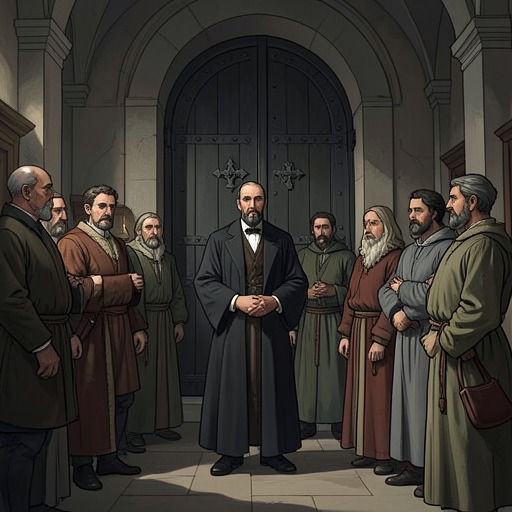
Thomas Wolsey
The King's CurseThomas Wolsey’s defining achievement is to make himself indispensable to Henry VIII: he can move an army, organize the work of government, and reach into the king’s private councils. The same concentration of influence makes him a target for rivals and leaves him exposed when the king’s demands collide with Church authority. As the king’s adviser and a papal legate, Wolsey becomes a central figure in the struggle over Katherine of Aragon’s marriage; his departure from court, ill and isolated, fulfills a warning that his support for the king’s course will destroy him.
Administrative Power and Royal Service
Wolsey first appears as a practical organizer rather than a figure whose importance rests only on rank. When the court and the king’s sons are absorbed in preparations for war, he directs the movement of an army by attending to its material needs: where goods must go, how troops are mustered, and when transport and supplies must be ready. He orders smiths to forge pikes and saddlers to make leather jackets. The narrative emphasizes the repetitive detail of this work, the very business that noblemen are said to neglect. Wolsey’s ability to manage it makes royal ambition operational.
That capacity also shapes how his political opponents describe him. The Duke of Buckingham disparages Wolsey as a man whose knowledge is practical and transactional: he knows prices and English towns, can identify what Parliament’s members can be bribed with, and understands the secrets they conceal. Yet the same attack concedes the source of his ascendancy. Wolsey can obtain what the king wants, sometimes before the king has decided to ask for it. The duke contrasts this with the earlier political order, when Katherine’s counsel helped define England’s friendship with Spain, hostility toward France, and reliance on the nobility. Under Wolsey, the court can no longer be sure where policy is leading or who will be treated as friend or enemy.
Wolsey’s rise changes the daily distribution of power as well as the direction of policy. As Archbishop of York, he takes Katherine’s place in Henry’s private councils and displaces the other advisers in the council chamber. He works across offices and treasury rooms, accumulating positions and fees that could otherwise be spread among many men. His labor frees Henry to pursue new attachments, while Katherine is left to maintain a public appearance of composure. Wolsey’s administrative reach thus reaches into the royal marriage: the queen’s diminishing access to counsel and the king’s freedom to turn elsewhere occur alongside his growing control of government.
Rank, Influence, and the Royal Marriage
Wolsey’s advancement also carries ecclesiastical authority. His appointment as papal legate is described at court as an honor from the Pope that costs the king little; the remark that the cardinal nevertheless seems always to get what he wants captures the unease beneath the celebration. His authority now comes with a title and a commission beyond the king’s immediate household, even as his practical influence remains tied to Henry’s favor.
That combination becomes especially consequential when Henry seeks to leave Katherine. The question of whether her marriage to Prince Arthur was consummated has long been politically charged: Katherine maintains that it was not, while her opponents regard that claim as a threat to the king’s marriage and dynasty. The narrative later presents Wolsey as telling those around the king that a priest’s duty to the king outweighs an oath to the Church. He is also said to believe that the Pope would agree to the desired course and that Wolsey could arrange it. These claims place him at the point where royal policy, ecclesiastical procedure, and personal allegiance meet. Rather than simply carrying out an administrative task, he appears to be helping the king turn a contested marriage into a matter to be resolved in the king’s favor.
The stakes are sharpened by the succession. Katherine has suffered repeated losses, and the death of a royal infant makes the absence of a surviving male heir an immediate anxiety within the court. Courtiers imagine that a son born to Katherine, even late in her life, would restore her standing and eclipse both Wolsey and the women competing for Henry’s attention. His power, however extensive, remains vulnerable to the possibility that the queen might provide what the king’s dynasty lacks. The contrast is revealing: Wolsey can control supplies, offices, and access, but he cannot supply an heir.
Rivalry, Warning, and Departure
The narrative presents Wolsey’s influence as entangled with rivalry at court. A small incident involving water staining his cardinal’s-red robes is remembered as a mark that would later be blotted out in blood red. The account interprets this as part of a long campaign: Wolsey wants revenge on a rival for the king’s affection and attention. The stain becomes a compact image of how courtly affronts persist within larger struggles for access and power, although the account does not make the later outcome depend on that incident alone.
Elizabeth Barton, known as the Holy Maid of Kent, gives Wolsey’s political choice a prophetic frame. She says that she warned him directly that helping Henry leave his wife and supporting a marriage to Anne Boleyn would bring his complete destruction and an ill, lonely death. Geoffrey Pole responds that it happened. Barton also recalls warning Archbishop Warham that failure to speak for Katherine and her daughter would end in illness and loneliness; she says Warham has since died. Her warnings to Thomas More remain unresolved at the time she recounts them. These predictions do not explain Wolsey’s fall through a documented chain of decisions, but they make his support for the king’s marital project the decisive choice in the story’s moral account of his fate.
Wolsey eventually leaves court. The narrator withholds from another person the fact that Barton had predicted he would die miserably alone if he encouraged Henry to abandon his wife. By then, Wolsey is described as alone and in failing health. The withheld warning creates dramatic irony: while the court can see his absence and declining condition, the narrator privately connects them to a forecast that has already come to pass. His departure is not presented as a triumphant retirement or a settled reconciliation, but as the narrowing end of a career built on proximity to the king.
The Succession of Ministers and the Limits of Power
Wolsey’s legacy becomes visible in the men who take up the work he once controlled. After Thomas More resigns as Lord Chancellor, Thomas Cromwell becomes a dominant figure in royal government. The narrator likens Cromwell to a Fool dancing in his master’s boots, an image that makes succession look like an uneasy imitation rather than a clean transfer of authority. Later, Cromwell’s private chamber is shown crowded with men bent over letters and account books; the work of the world seems to revolve around him, as it once revolved around Wolsey. The administrative machinery survives its master.
The political settlement, however, changes more radically than the offices. When the Church yields to Henry, the king is presented as ruling it himself, with the Pope reduced in England to the status of a bishop. More returns the seal of the chancellorship and withdraws from office rather than serve that arrangement. The scene clarifies the danger of Wolsey’s position in retrospect: a minister who tries to serve royal policy through ecclesiastical office is caught between authorities that the king increasingly refuses to treat as equal. The narrative does not claim that Wolsey caused this settlement, but his career anticipates the conflict it makes explicit.
Cromwell’s own position exposes another consequence of Wolsey’s example. He is described as pale after an audience with Henry, and the narrator imagines that he must summon courage to face the king he has helped to make. Others explain his fear by recalling what happened to his former master: if the king turns against Cromwell, he has few friends, and the laws he has devised can be turned against him. Wolsey’s rise and departure therefore form more than a portrait of one powerful adviser. They establish a pattern in which skill and proximity bring extraordinary influence, but offer no durable protection once the king’s favor shifts. His fall is the shadow cast by the very system his service helped to make effective.